A little door piz-ainting…

Piz-ainting? Why yes, that’s a little gangsta speak for your Friday reading pleasure.  Word. 😉

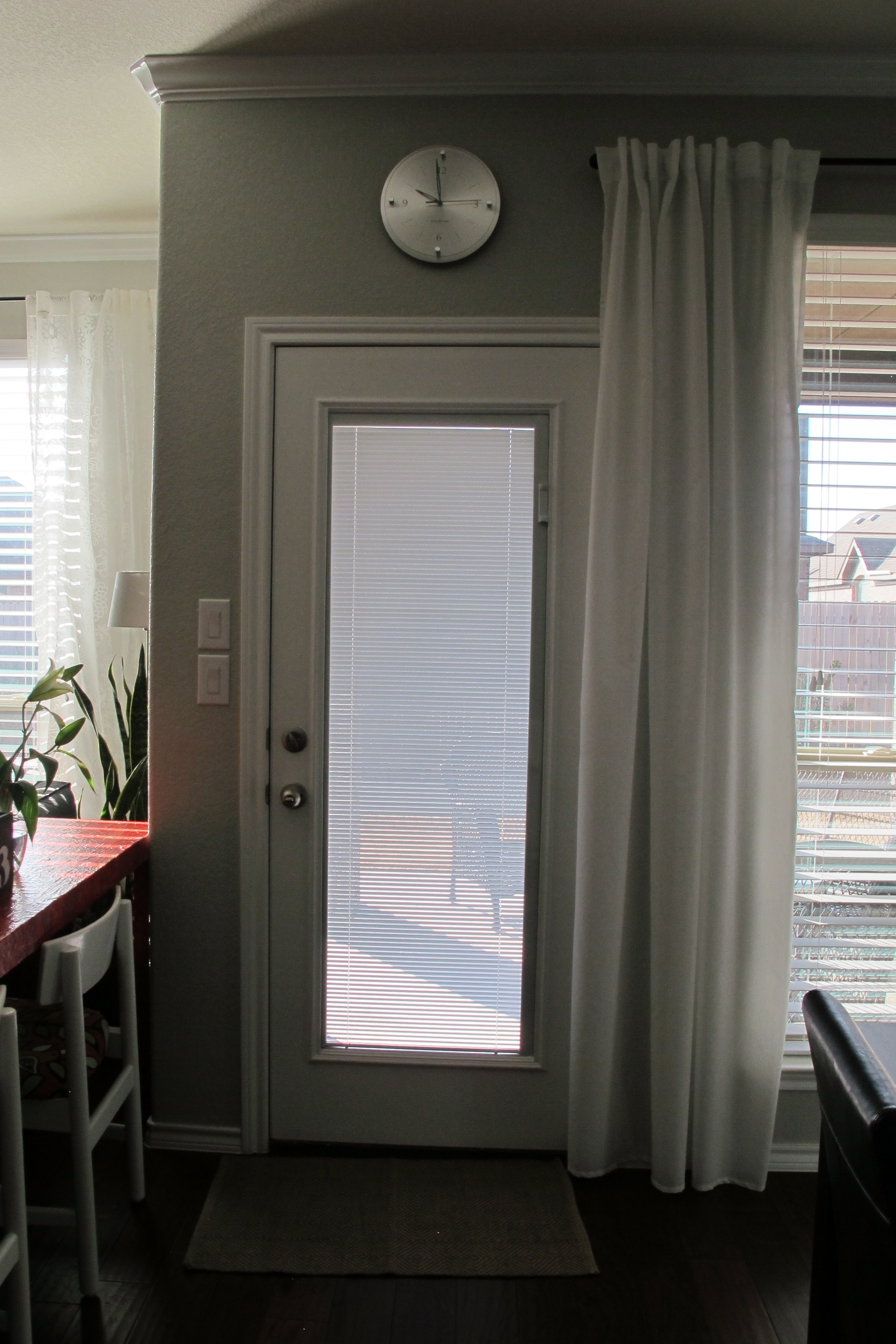
So, what is this painting of which I speak?  Why, let me introduce you to our back door….
IMG_3211

He’s a likeable guy.  Functional.  Happy to provide privacy when needed.  He’s quiet.  Not much of a talker.  Which suits me just fine.   Only problem… He’s a little dull.

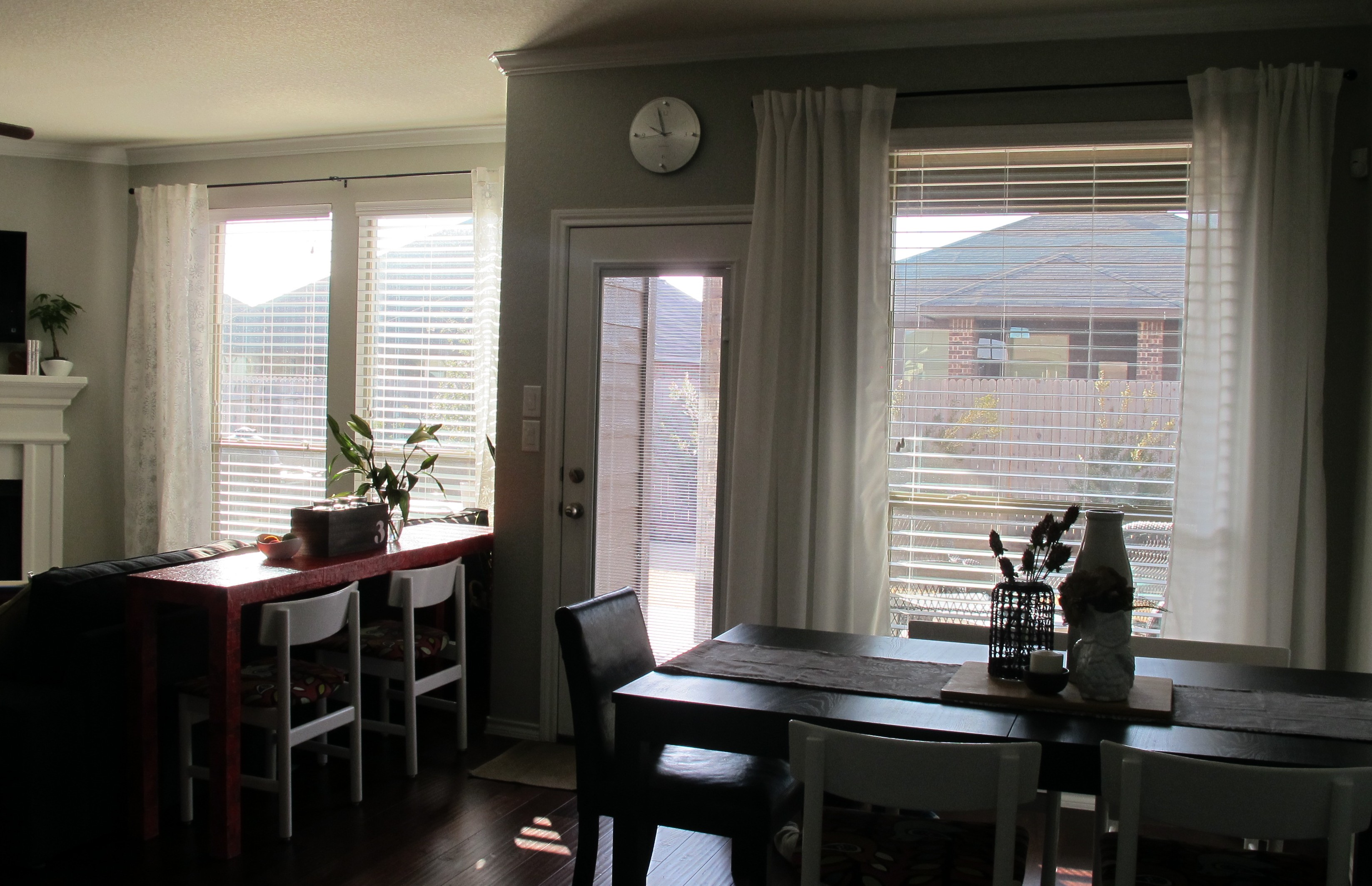
Don’t get me wrong… white doors are nice.  We’ve got plenty of ’em.  Its just, when you take in the room from this standpoint….
IMG_3208

It’s a lot of white.   White curtains, white blinds, white trim, white door, white fireplace.   Now, I like white.  A lot. Obviously… I mean, it’s everywhere in our house.  But I LOVE contrast.  Pop.  Excitement.  So, I decided that this quiet soul deserved a makeover.  A charcoal makeover.   I decided that charcoal was the man of the hour because it’s a fun contrast, but it’s more casual than a deep elegant black.  Plus, since our front door is stained an ebony color, I thought the charcoal would bring in a nice consistency among our exterior doors… Darker-toned but not quite black.

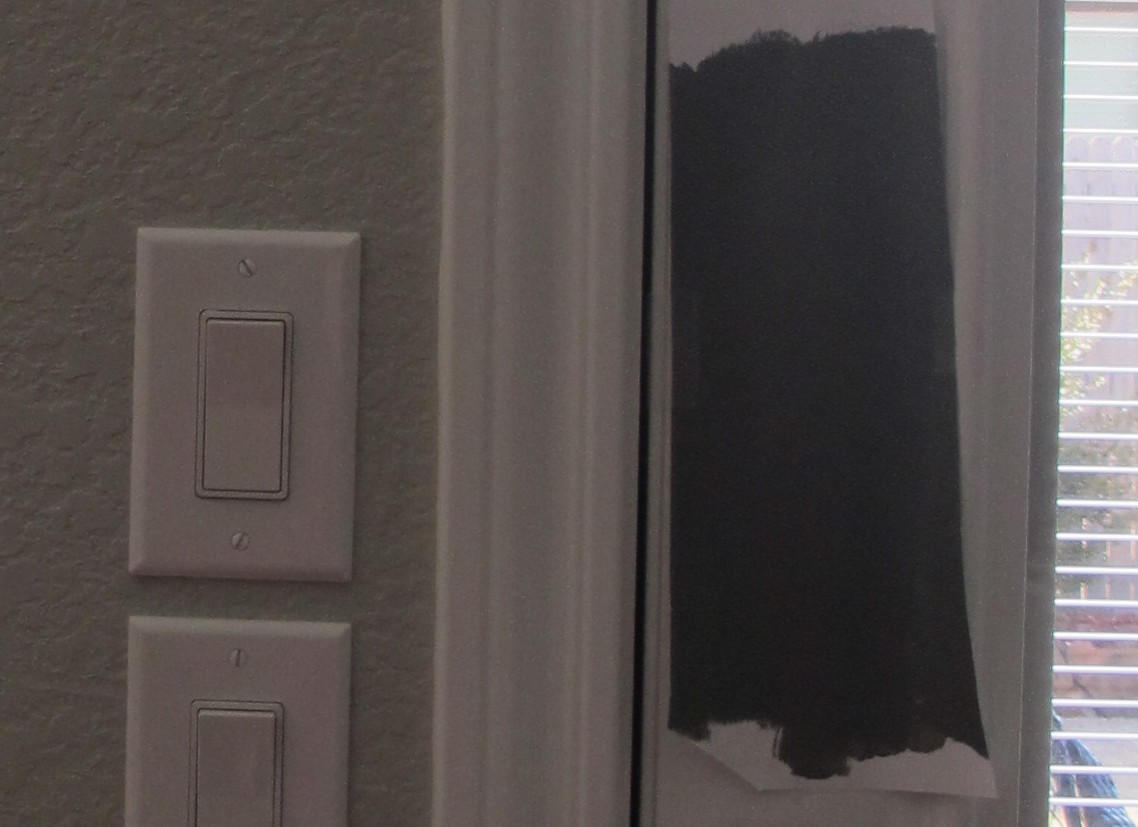
A while back (as in, pre-blog days) I’d planned to paint our fireplace a dark color (and have since changed my mind).  I purchased a quart of deep grey paint (Rockport Grey by Clark & Kensington) for this very job but never ended up using it.  Since I already had the paint on hand, I just assumed that I’d use it to paint our back door.  But, then I hesitated.  It’d been a while since I’d seen the actual color and I wanted to be sure. To be on the safe side, I painted a swatch of Rockport Grey onto a piece of cardstock and taped it to the back door.  And boy am I glad I did…
IMG_3078

It’s hard to tell from this awful pic, but the undertones of the Rockport Grey (which are more blue) don’t go with our Dolphin Fin wall color (which has more of a green undertone).   It’s crazy how colors can read so differently in another room (or another part of a room in this case).   The angle of our fireplace and the difference in lighting due to the large windows in the living room allowed the Rockport Grey to take on more of a green cast which went great with our wall color when it was displayed on the fireplace.  Our windows are Low-E windows which have a slight green film to them (you can see it from certain angles when you stand outside) so the larger and brighter the windows, the more of a green cast the light provides.   The smaller windows in our breakfast nook don’t provide as much light because they’re under the covered porch, so… less green.   Which explains why the Rockport Grey appeared more blue in this part of the room.   If there’s one thing I’ve learned since moving into our house it’s that it’s always a good idea to hang paint swatches in multiple areas of a room (during multiple parts of the day) to make sure your chosen color is truly what you want.

After realizing that my paint was a no-go, I headed to Lowes and picked up a bunch of charcoal swatches and taped them to the door.  Enter the three finalists…

IMG_3203

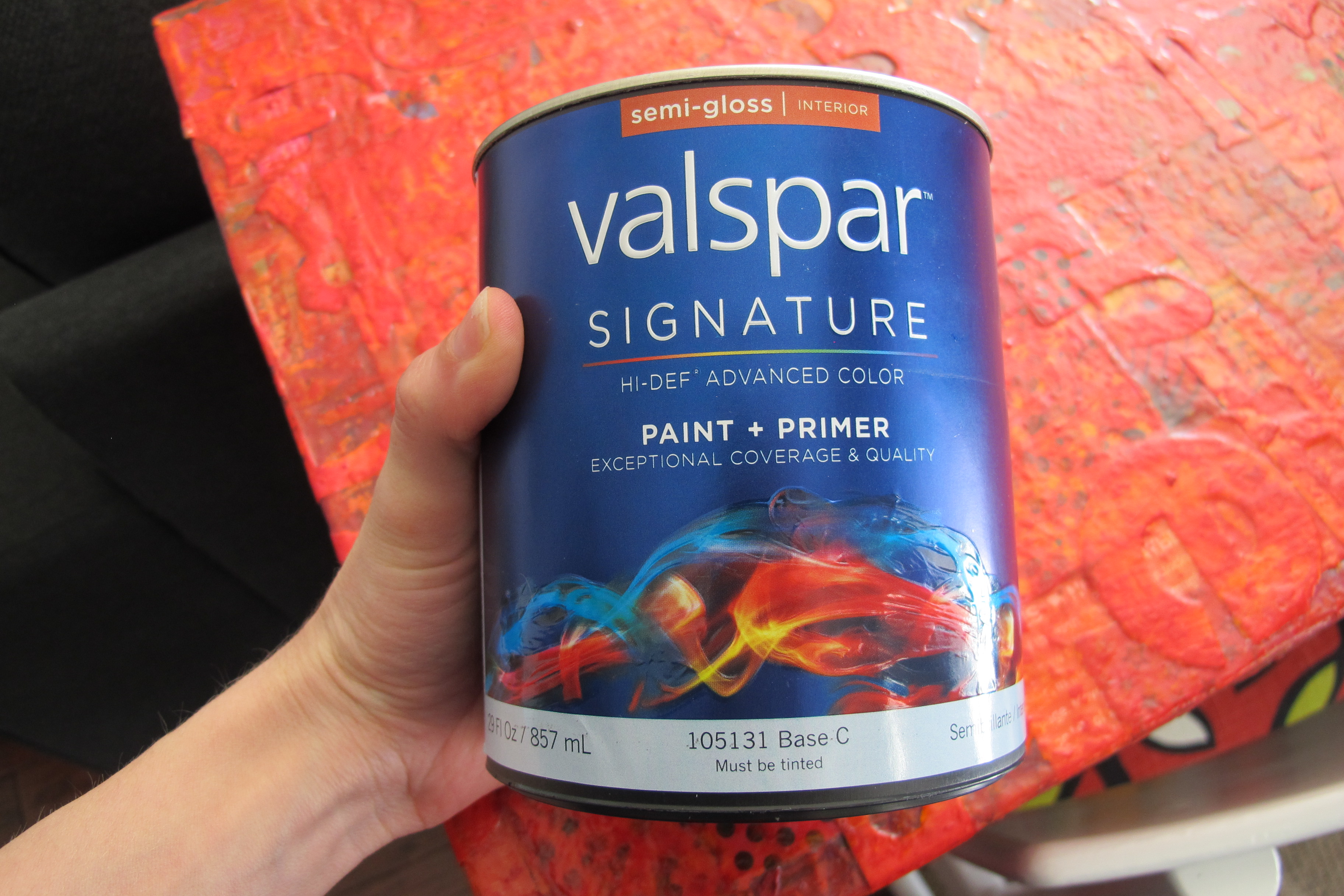
They stayed up there for about a week because I wanted to be sure that I liked my pick in all types of lighting.  In the end, the winner was the top swatch (Ebony Field by Valspar).  I went back to Lowes and picked up a quart of primer+paint in semi-gloss to save me a priming step…
IMG_3217

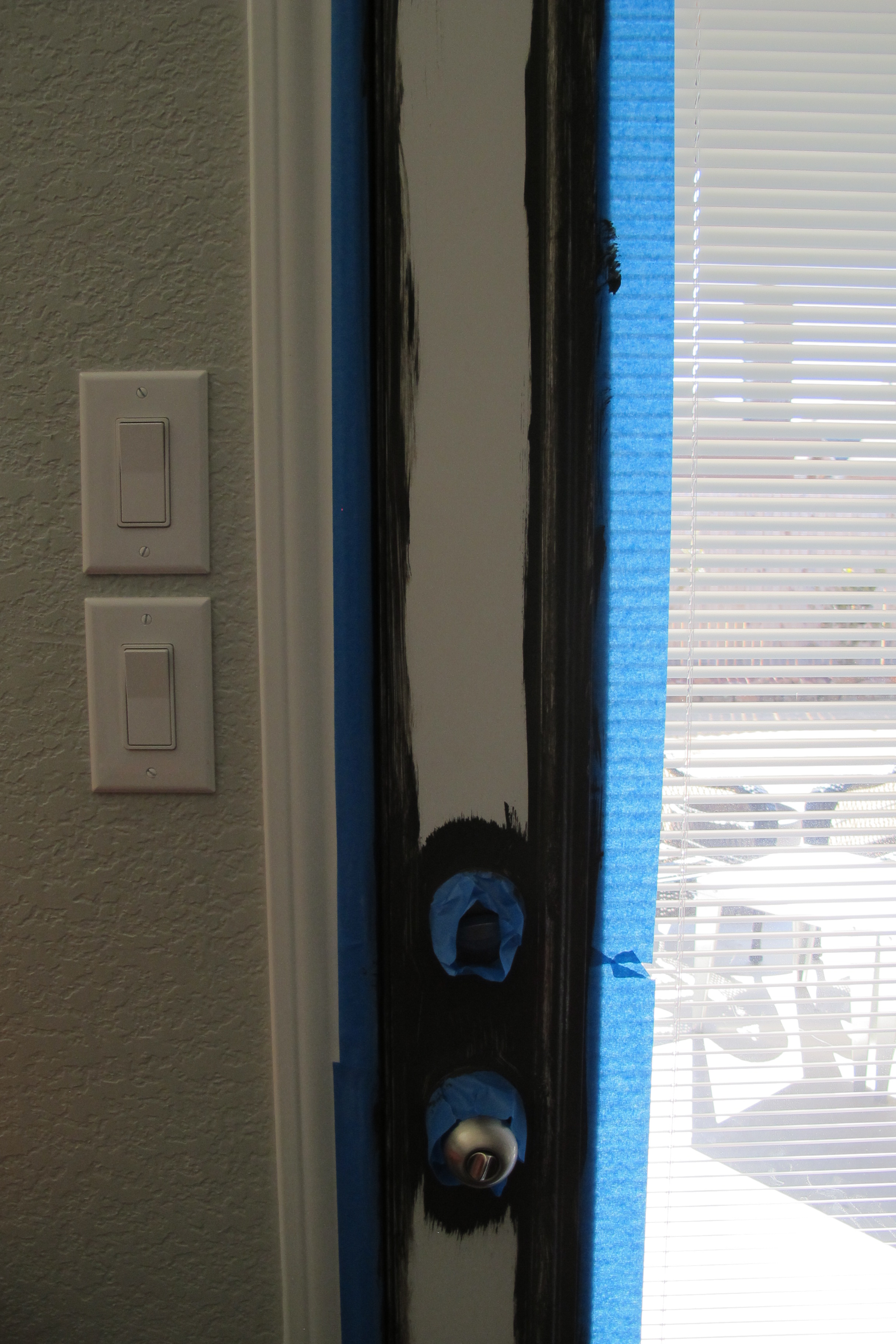
I prepped our door by thoroughly cleaning it with my water/vinegar spray to remove any dust or dirt, then I wiped it down thoroughly with a deglosser (which is basically liquid sandpaper).  I taped around my hardware, window and door with painters tape…

IMG_3216

In a perfect world, I would’ve removed my hardware, but it was a really windy day and I was afraid that the door would swing open and ruin my paint job if I removed them.  Also, I’m still very much a beginner in the photography department so I’m sorry about how dark some of these pics are.  I’m working on it for sure! 🙂

Now, it was time for painting.  I used my favorite angled brush and a small foam roller. I brushed around the trim…
IMG_3220

and rolled the flat parts…

IMG_3223

I applied a thin and even coat of paint, being careful to avoid drips.  Then, I allowed the paint to dry thoroughly.  Once it was dry (here it is after one coat)…
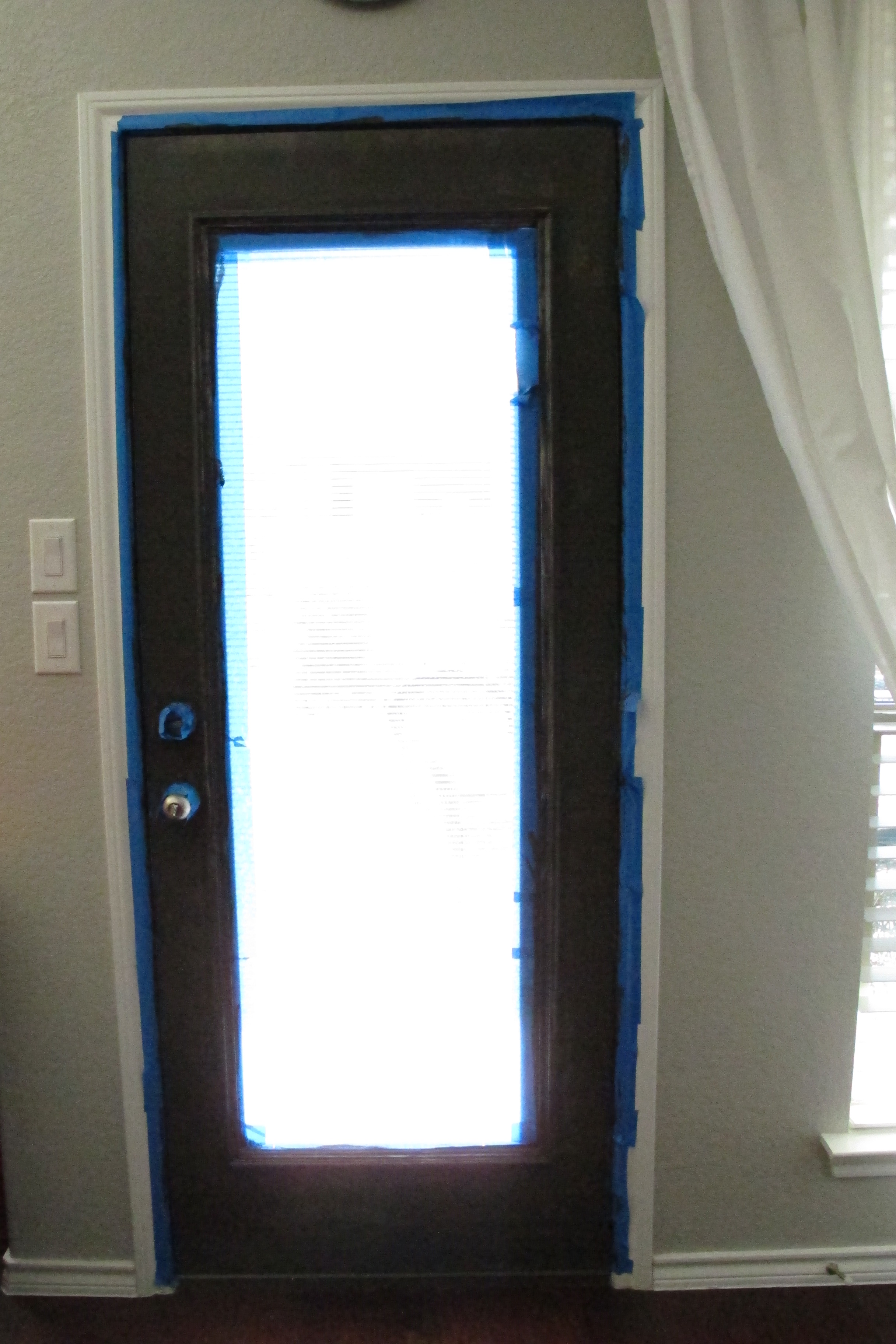
IMG_3227

…I began to brush a second coat onto the window trim…  which is when everything fell apart. Sort of. I tried to remove a small piece of painters tape from the window. And a large portion of my freshly-applied paint peeled off with it.

IMG_3235

Oh no.

That’s when I realized that the trim around the window is plastic, not wood as previously thought. And apparently, our builder had painted white, water-based paint over it without properly prepping the surface. Oy. So, I had prepped MY surface well. My grey paint stuck to the white paint just fine… The white paint just had nothing to cling to in return with all that slick plastic beneath it. So, when it was moistened with wet paint it totally bailed.

Needless to say, I was a smidge on the frustrated side at this point (understatement).. I explored the door further and realized that the peeling was only an issue on the trim around the window. The actual door was fine. So, I used a razor to score the paint between the trim and the door and then scraped the rest of the paint off the trim with my fingernail. It practically fell off. In large clumps, too. Which left this…

IMG_3236

Attractive, huh? I used 220 grit sandpaper to rough up the plastic and dispose of any small bits of paint that were left. Then, I wiped down the trim with a deglosser (again). And I busted out the big-gun shellac primer (Zinsser BIN primer) and applied an even coat to the trim with a foam brush. Then, I called it a day and watched How To Lose a Guy In 10 Days for the hundredth time.

The next morning, after enjoying my giant cup of coffee (whilst whispering sweet nothings into my cup), I got on it with my next coat of paint. I brushed paint onto my newly prepped trim and boy did it go on easy. I should’ve been whispering sweet nothings to my primer, ’cause that stuff rocks. Then, I rolled on another coat of paint to the flat planes with my foam roller. … And I started to get excited. I could see the final result starting to shine through. Nothing feels better than that moment where you see a project starting to come together and realize that you’ve made the right decision. I’ve never wanted to hug a door more in my life.

Anyhoo, I waited for the paint to dry and then applied one more thin coat (for a grand total of three thin coats). I scored the painters tape with a razor (just to be safe to prevent additional peeling). Then, I used the razor to remove any rogue paint that had gotten on the glass. Once it dried it looked like this….
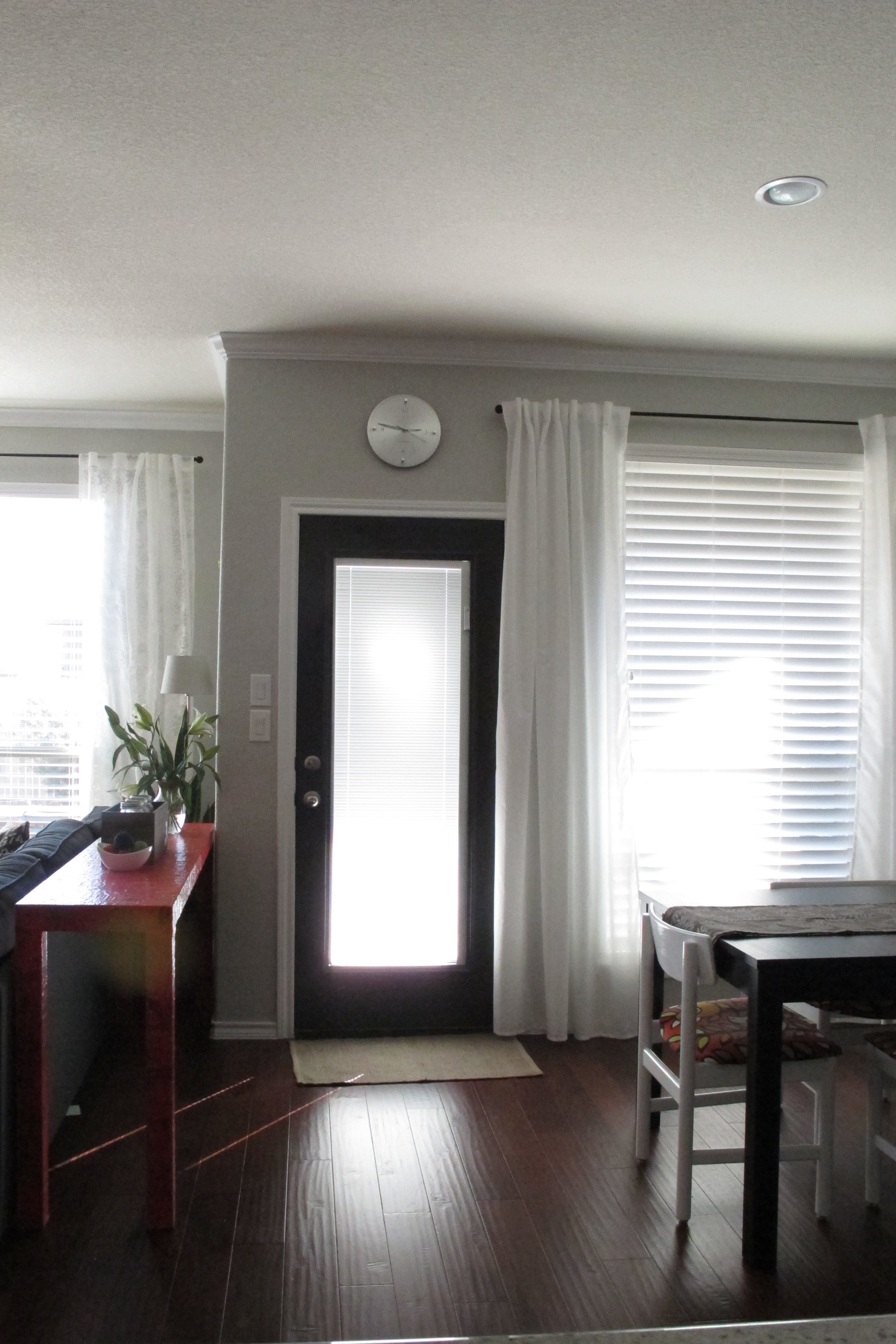
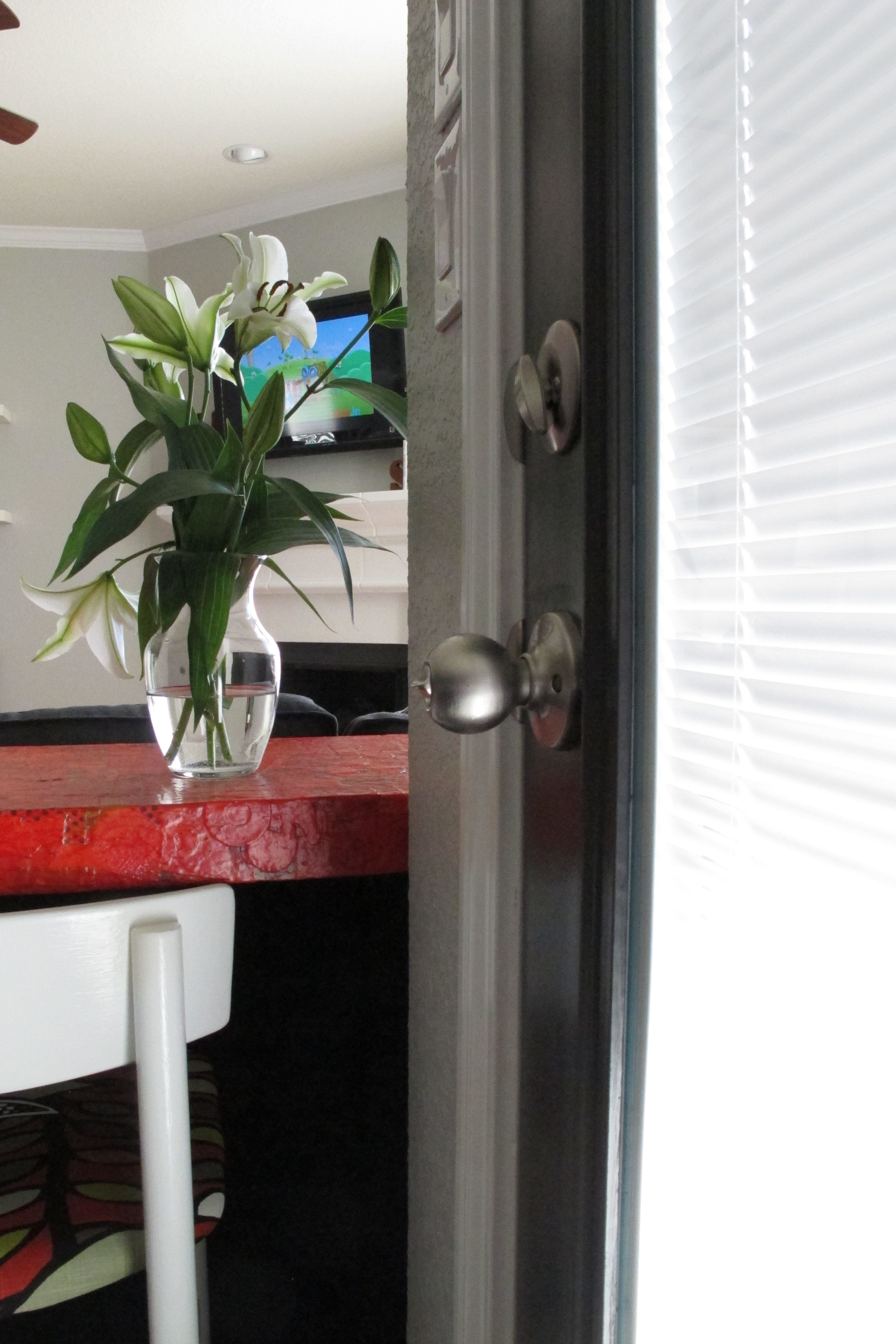
IMG_3264IMG_3263IMG_3248

Hello, lover.

I need to redecorate a smidge around this area now to allow the door to shine.  In the first shot, I experimented with placing one of our bird chairs at the head of the table (instead of our black leather parsons chair).  Doing so definitely confirmed that a lighter, brighter chair is needed to replace the black one.   I ended up moving the black parsons chair back to the table afterwards since five bird chairs in one place looked far too busy, but now I’m definitely on the lookout for something new.    Different light, bright styling atop the sofa table is on the agenda as well.   I can’t wait to play!  So fun.

So anyways, that’s my door-painting adventure.  As with most of my projects, a few twists and turns made an appearance, but I reached my goal in the end (albeit in double the time expected).  It’s all par for the course, though, and I learn something new every time a project goes askew so it’s all very worth it in the end.   🙂

img_3264 (1)

DIY Stenciled Jewelry Organizer

Last time, I threw in a little sneak preview of my jewelry organization redo….

IMG_2577

Now, for the tutorial.

During my recent closet decluttering, my jewelry box and necklaces were relocated to a shelf on the opposite side of our closet.   My previous method for organizing necklaces was simply thumbtacks…

IMG_2574

I decided that I wanted something just as functional, but better looking (which didn’t result in 30 more holes in the wall).    So, I went to Home Depot and picked up a piece of pegboard for $8.96 along with some small hooks for around 3 bucks.   I figured that I’d paint the pegboard to make it more attractive and hang it behind my jewelry box.

The white side of the pegboard was pretty glossy, so I used this deglosser…

IMG_2576

You simply rub it on with a lint-free cloth and it, well, deglosses the surface so that paint can more easily adhere.   It’s basically liquid sandpaper. Once dry, I applied a coat of shellac-based primer since I wasn’t sure what would work best on the pegboard.  Shellac-based primer entered my life here and I fell in love.  It’s a bit more expensive than other primers and pretty stinky but it works in situations where other primers may not.  During my various Pinterest adventures, I’d read a few pegboard painting tutorials where the main complaint was that paint didn’t easily adhere to pegboard and would soon chip off. So, I decided to err on the side of caution and go for the big guns.   I applied my primer coat with a small foam roller in the garage with the door open for ventilation.

The next day, I brought the pegboard inside…

IMG_2555

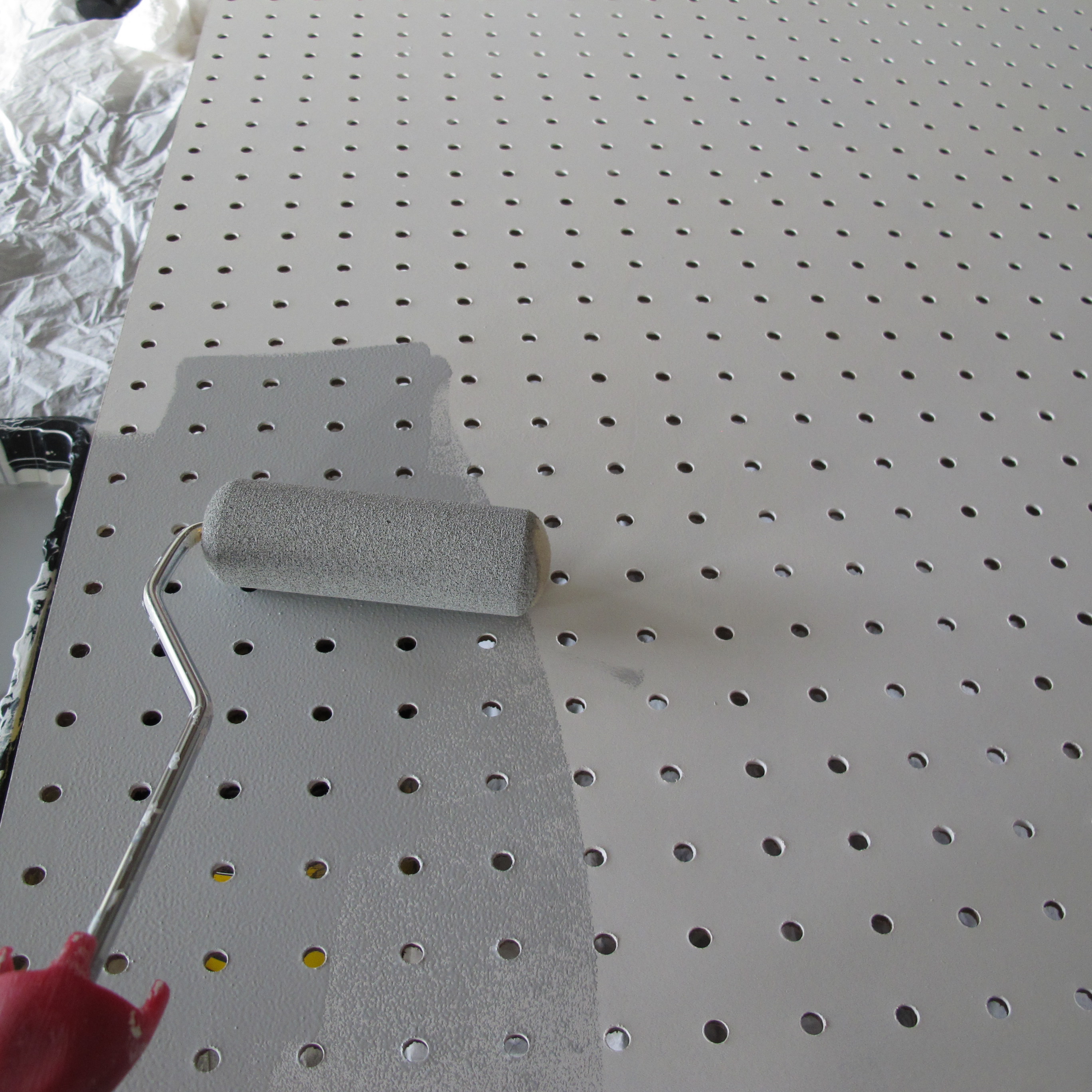
…and applied two coats of the grey-blue paint that I’d used in the laundry room (seen in this post).  It was an oops! paint that I got for super cheap on the mis-tint rack.    I used a small foam roller, applied one thin and even coat…

IMG_2556

…waited about 2 hours, then applied another. Then, I let the paint dry completely.

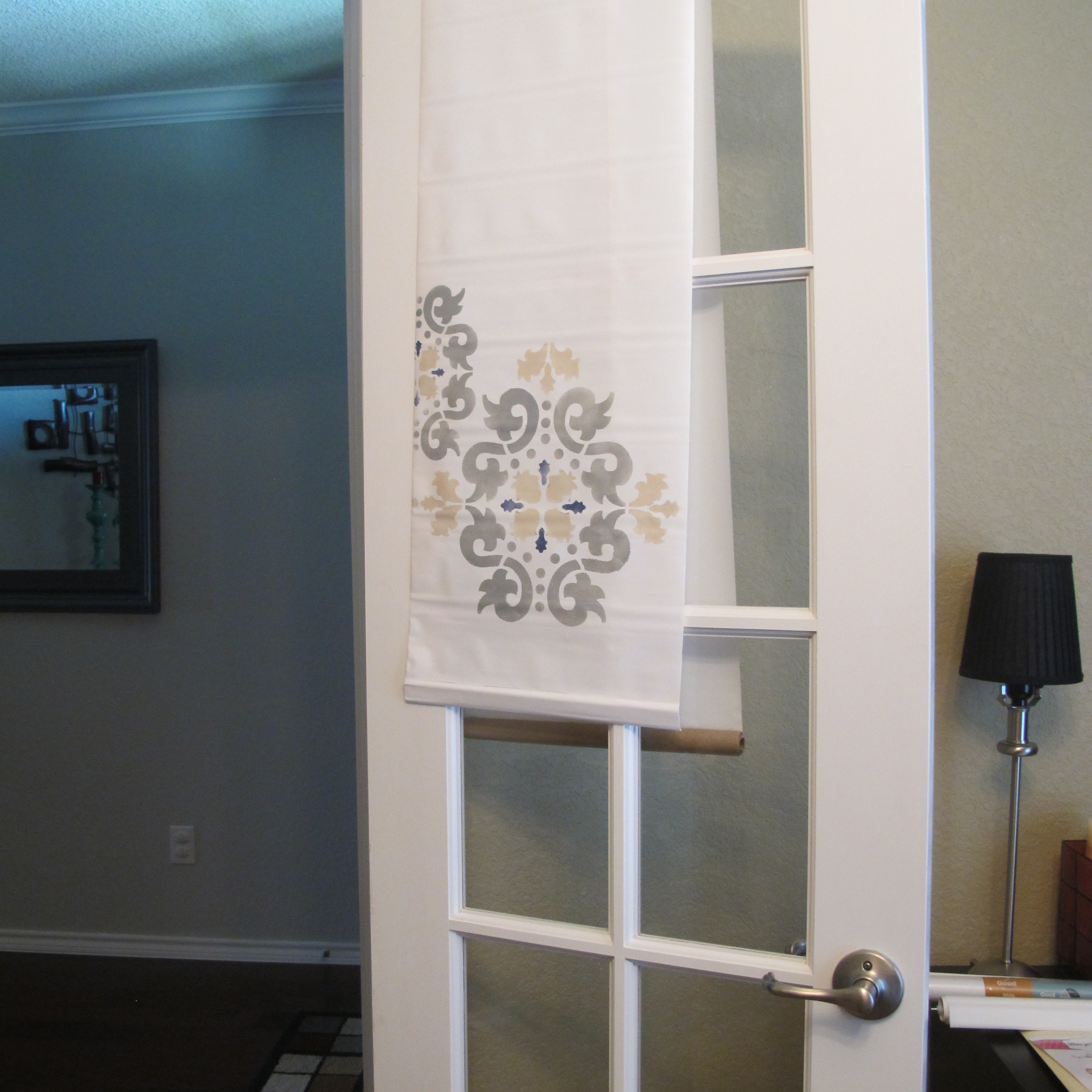
Next, I wanted to add a little interest.  I’d purchased a stencil from Hobby Lobby for my roller shade project, but aside from this one little test stencil, I didn’t end up using it….

IMG_1155

I’ve been wanting to utilize the stencil since then and figured that this would be the perfect opportunity.   Especially, since if it didn’t work out, the pegboard would be in my closet, where nobody would see it (unless I chose to stick it on the internet for all to see. Which I would. ).  Up until this point, I’d never attempted an all-over stencil.  I chose some white Clark & Kensington paint + primer that I had in the garage for the stenciled design.  And I assembled my materials…

IMG_2560

I started by lining up my stencil so that it was straight.  This was pretty easy since I could just line up the little triangle indicators (not shown, but they’re obvious when you look at the stencil close-up) on the stencil to the pegboard holes.

IMG_2561

I marked my triangles with a pencil so I’d know where to line the stencil up as I moved along.   The instructions on the stencil package recommend that you start in the middle top of a wall, but since this was just pegboard and the portion that I started on would be hidden behind clothes, I just picked a random spot. I used small pieces of painters tape to hold the stencil securely.

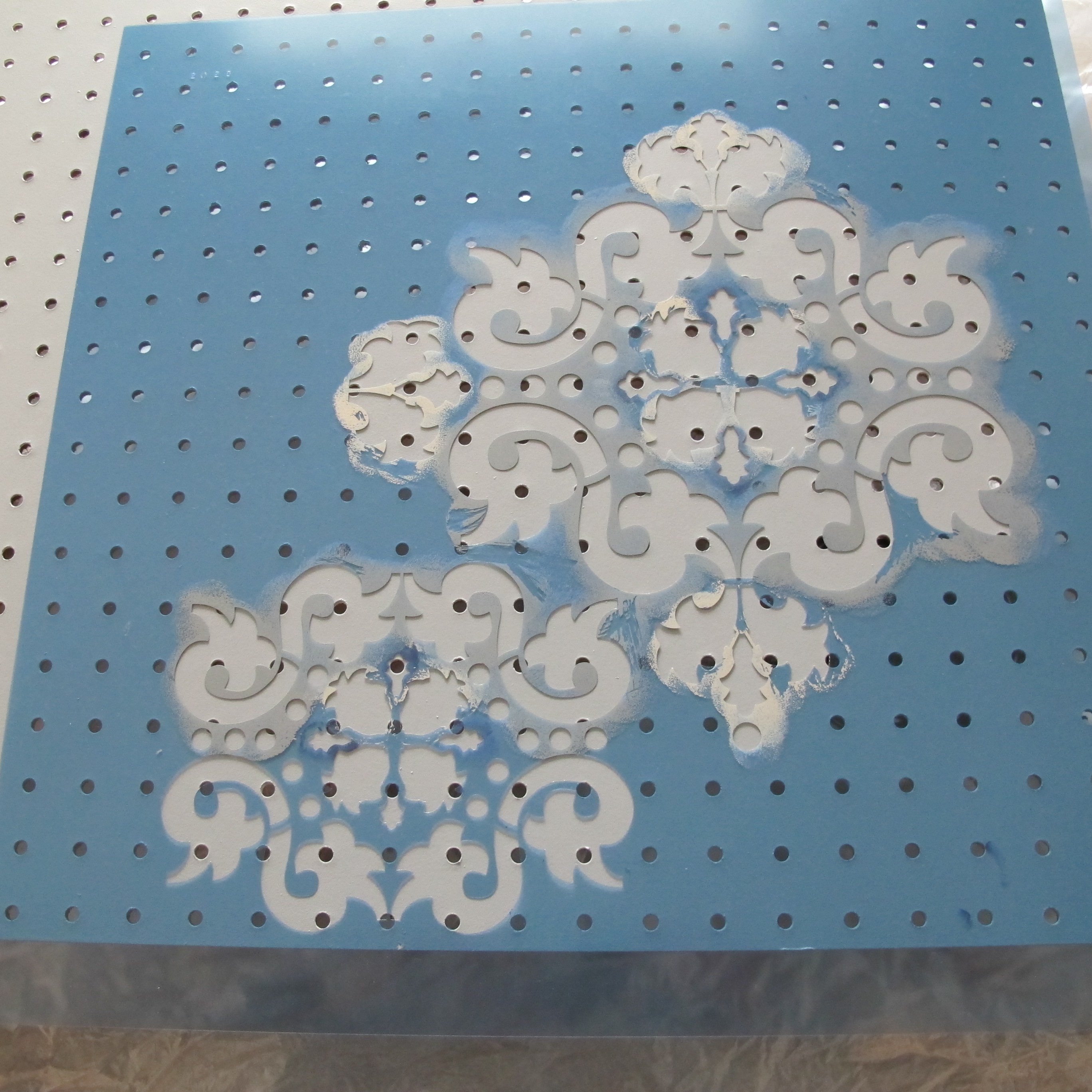
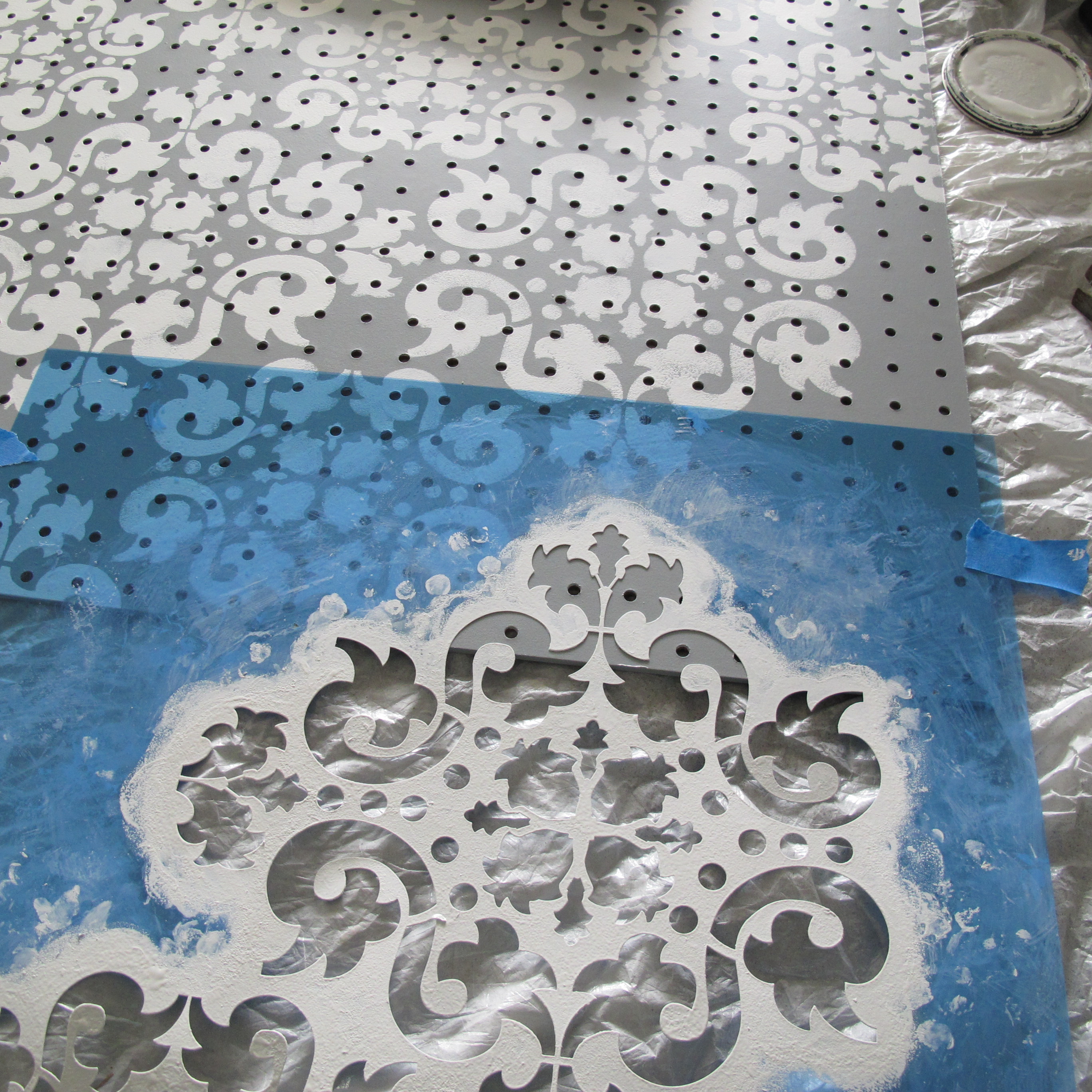
Then, using a foam stencil brush I lightly stippled the paint over the  stencil.  When I was done, I carefully lifted the stencil to reveal this…

IMG_2563

My first go went okay.  Crisp-ish lines, not too shabby.  I did realize that I needed to use a little less paint on my brush and dab a bit more consistently after examining my first attempt.

Now, the problem with this project (mixed with my personality) is that it requires patience.    Once the first stencil was done, I had to wait until the paint had dried to move the stencil and start again.  I’m not sure if I oriented the stencil wrong to begin with or if this is typical, but the waiting part was a total bummer. I was all gung-ho about mastering the stencil.  Like, NOW. But no, we must wait. Ugh.

The directions also recommended that paint not be allowed to dry on the stencil.  I had issues with this as the paint dried so quickly that by the time I had an opportunity to wipe the stencil down with a damp rag, it had already dried.  Especially around the edges of the stencil, which is the most important part.

Because of the dried paint, I noticed that I had to work harder to get the stencil to lay flat when stippling paint, which lead to unsightly bleed-through like this…

IMG_2567

Now, I should’ve used a stencil adhesive to aid in this.  You spray it onto the back of the stencil so it sticks to your surface and prevents bleed-through.  Goodness knows, it would’ve made this process a whole heck of a lot easier and the end result crisper. Unfortunately, by the time I realized this fact, I was too involved in the project and much to lazy to make a trip to the store.  Kind of a “well, I’ve gotten this far…” sort of thing.  So, I just walked my fingers around the stencil pressing it down as I stippled on paint.  It worked okay, but was more time consuming and definitely not fool-proof.  So, seriously, take my advice… Recommendation #1: If you want to attempt an all-over stencil, buy stencil adhesive.

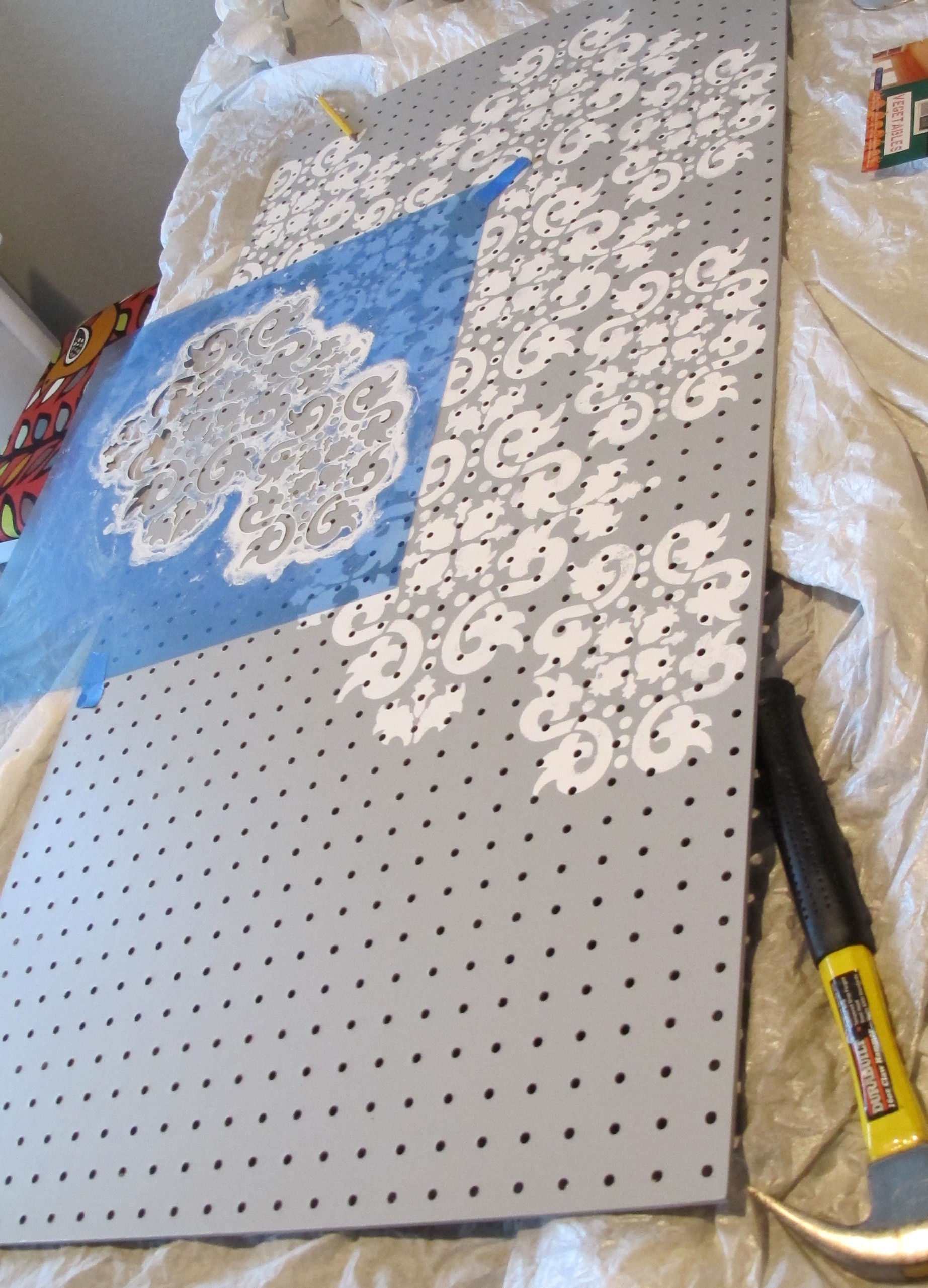
I slowly worked my way around the board, stenciling as I went….

IMG_2565

For the edges, I just lined up the stencil as usual and used painters tape on the dried areas to keep the stencil from sliding…

IMG_2566

The process of lining up the stencil was easy thanks to the little triangle indicators.  Unfortunately, half of the time I forgot to mark them (Doh!). I had to just be patient (Ugh.), wait for the paint to dry, then realign the stencil and mark the triangles so I could move on to the next area.   Recommendation #2:  Remember to mark your triangles.

Finally, I finished stenciling and touched up some of the messier areas with a small painters brush.  The stenciling took about a day and a half of intermittent painting with dry-times included (along with a birthday party which we attended).

Here’s the board finished….

IMG_2568

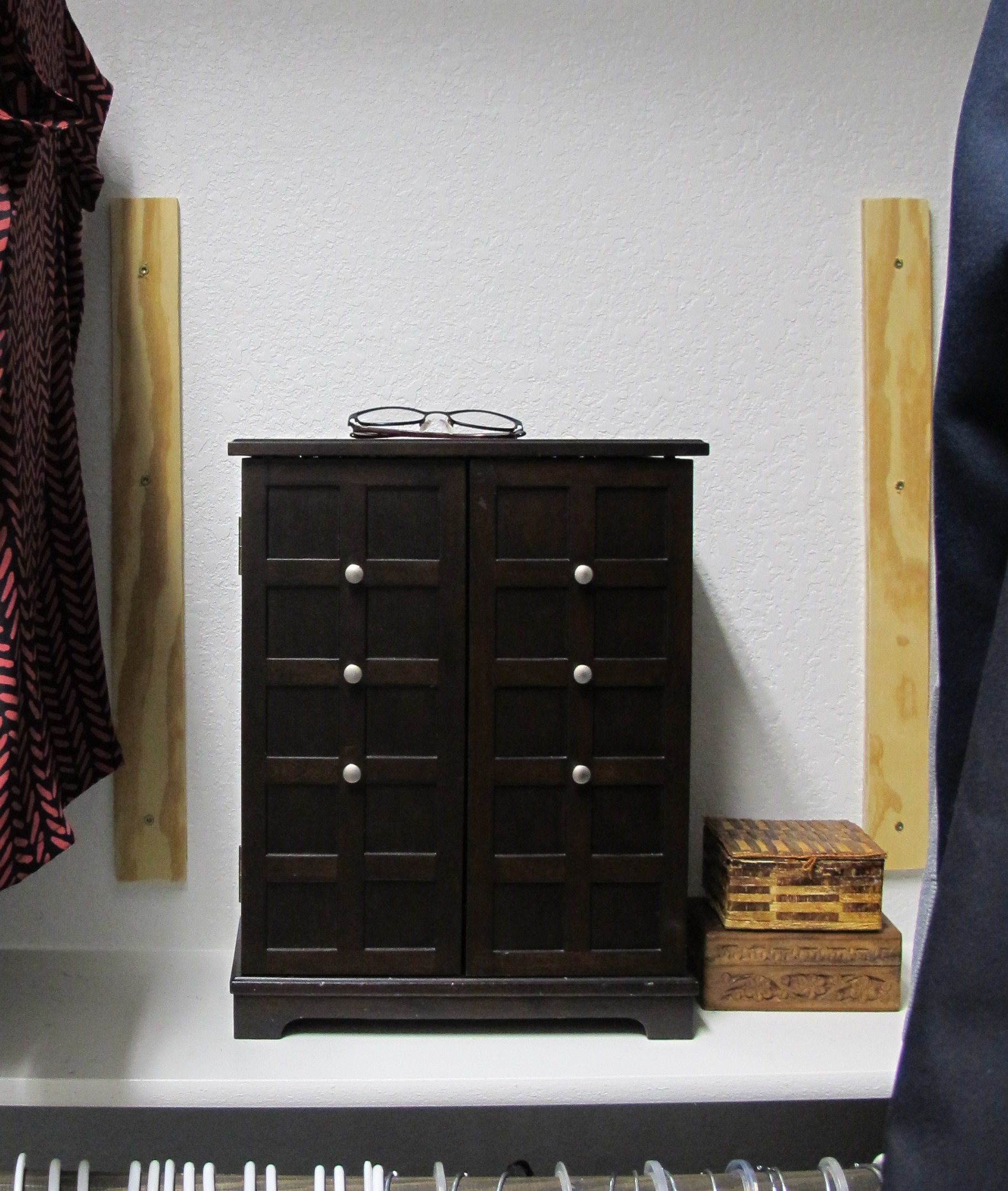
To mount the board, Joey cut a few strips of plywood down to size and secured them to the wall. He used screws and drilled them into the studs.


 IMG_2573

The plywood would allow the pegboard to sit away from the wall so the jewelry hooks would have space to sit behind it. Then, he screwed the pegboard to the strips.

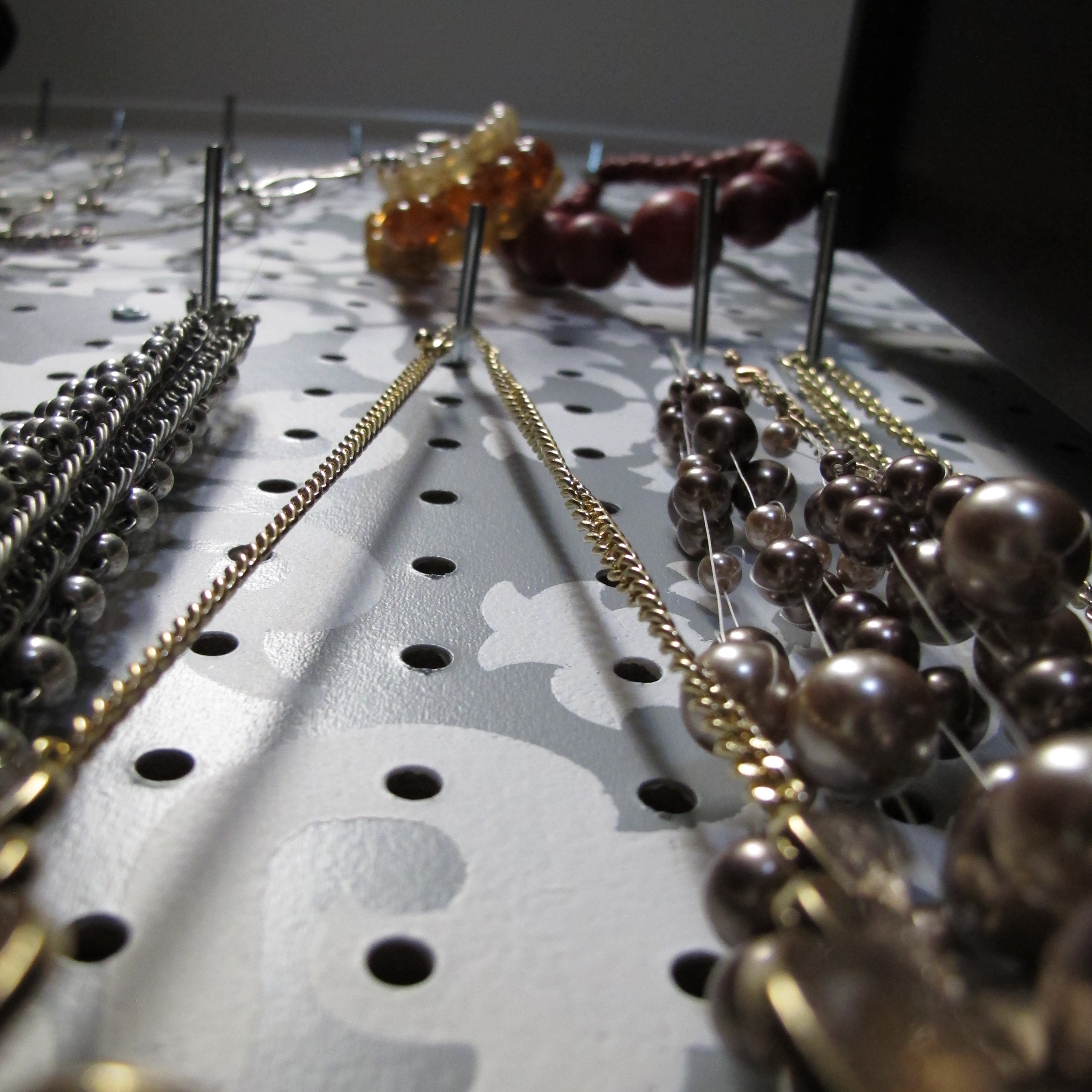
After it was mounted and my jewelry hung, it looked like this…

IMG_2864 IMG_2863 IMG_2592
I’m pretty happy with the finished product.  It adds a little sophistication to an otherwise “blah” closet. And I’m loving the functionality of it.  The fact that I can easily move the hooks around as I see fit without putting additional holes in the wall.

I’ll also say that I’ve learned something about myself in completing this project…  I’m not a natural stenciler.    I absolutely love the look of an all-over stencil job, but actually doing it is not really my bag.   I can see how it would be very therapeutic for some people, but I personally don’t have the patience to guarantee a consistently good result in the end.

So, I’m pretty glad that I took on this project before attempting an entire wall.  Especially since I’ve recently read a few tutorials about stenciling textured walls. Apparently, it requires MUCH more time and patience to produce a great result.   A one-time stencil?  Bring it.  All-over, not so much.   So, if I desire an all-over stencily pattern on my walls, I may consider splurging on wallpaper.  Otherwise, pattern will make an appearance in the room in other ways.  In any case, I’m proud that I attempted this. I’m proud of the end result.  And I’m proud of the realizations that came to be, which’ll hopefully save me from any future stenciling frustrations.   It’s okay to realize that I’m not meant for all DIY projects.  The important thing is to try them first to determine strengths, weaknesses, and preferences.

So, has anybody else taken on a project that they later learned was not for them?